Research Spotlight No. (3): Artificial Intelligence for More Accurate Radiographic Image Interpretation
25 Nov 2025
Researchers at Beni-Suef University contribute a study in the field of precise medical diagnosis. At the beginning of 2025, a study titled “Ulnar variance detection from radiographic images using deep learning” was published. The study addressed a highly specific medical issue: the difference in length between the ulna and radius bones at the wrist, which is a key factor in diagnosing hand and wrist disorders. Traditional methods for measuring this variance rely on manual measurements, which are time-consuming and prone to error.
The research team presented an innovative solution using artificial intelligence. They employed U-Net techniques to accurately segment the ulna and radius bones, followed by DenseNets to classify cases into three main categories: positive ulnar variance, negative ulnar variance, and neutral variance.
What distinguishes this study is that it did not rely solely on existing algorithms; the team built a new database of meticulously documented hand X-ray images to serve as a scientific reference for future model training. They also optimized model configurations to achieve the highest possible performance.
The results were remarkable: 97.7% accuracy in bone segmentation from radiographic images, and 92.1% accuracy in classifying variance. These results surpass previous studies and demonstrate that artificial intelligence can significantly reduce diagnostic time while enhancing the reliability of results.
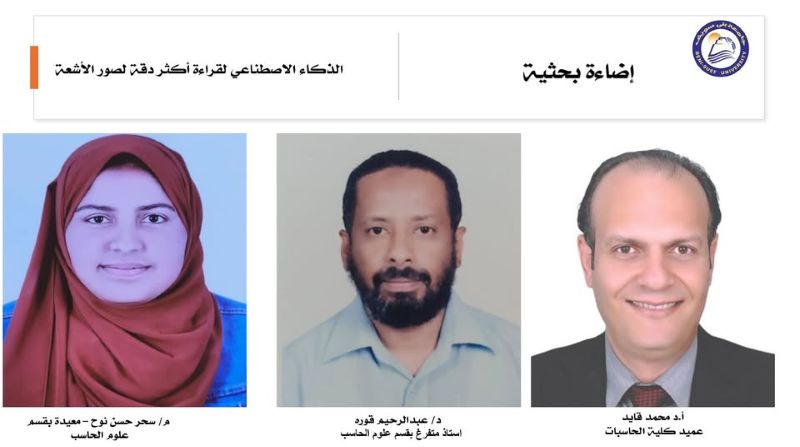
Authors of the study:
Prof. Mohamed Sayed Qaied – Professor of Computer Science and Dean of the Faculty of Computers and Artificial Intelligence, Beni-Suef University
Dr. Abdelrahim Qoura – Emeritus Professor, Department of Computer Science, Faculty of Computers and Artificial Intelligence, Beni-Suef University
Eng. Sahar Hassan Noah – Teaching Assistant, Department of Computer Science, Faculty of Computers and Artificial Intelligence, Beni-Suef University
Publication details:
The study was published in the Journal of Big Data, issued by Springer Nature, volume 12, article number 26 – 2025. The journal ranks among the top 2% of specialized computer science journals, is indexed in Clarivate Expanded Index and Scopus, and has a recent impact factor of 6.4.
Study link:
[https://doi.org/10.1186/s40537-025-01072-2](https://doi.org/10.1186/s40537-025-01072-2)
English Brief
Researchers at Beni-Suef University utilized AI to enhance wrist disorder diagnosis. Their model segmented wrist bones with 97.7% accuracy and classified variance with 92.1%. They built a new annotated dataset to train and validate deep learning models. Published in 2025 in Journal of Big Data (Springer Nature, vol.12, article 26, top 2%, IF 6.4, Scopus, Clarivate).